In brief
- Tube laser cutting helps prepare parts before assembly.
- It can integrate notches, mortises, openings, reference marks and welding tabs.
- It is especially useful for steel, stainless steel and aluminum projects.
- The earlier it is considered in the design process, the easier production becomes.
Tube laser cutting is not only used to cut a tube to length. When planned properly, it can make your parts easier to assemble, more consistent from one production run to the next, and better prepared for welding, bending or finishing.
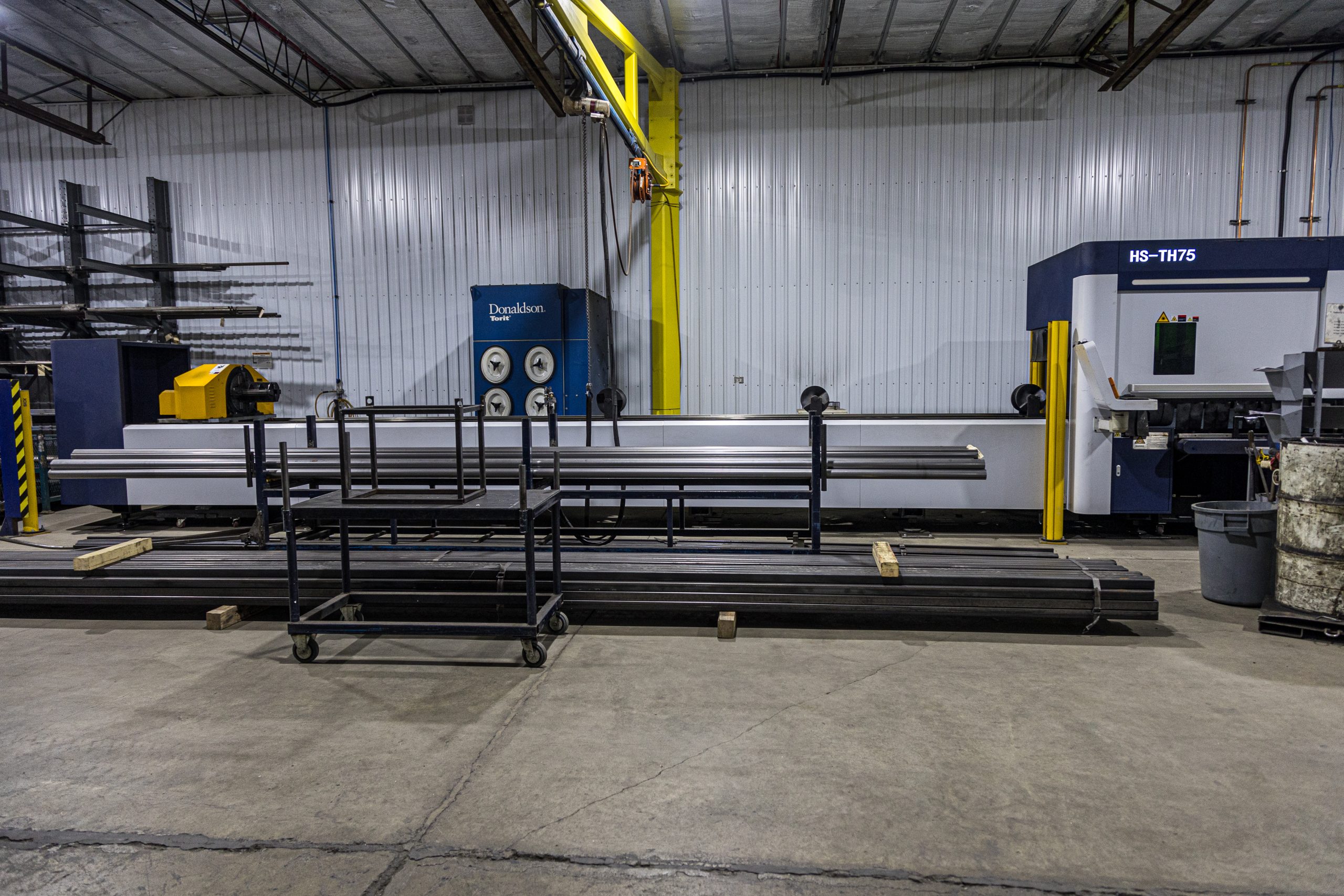
At Industrie Bourgneuf, our tube laser has been part of our technology lineup for more than 5 years. It allows us to work on metal tubes with precision while preparing details that help position parts more efficiently in the shop.
The goal is simple: think about assembly before manufacturing begins.
Why should tube laser cutting be considered early in the design process?
Thinking about tube laser cutting early in the design process makes it possible to turn a tubular part into a part that is already prepared for assembly. Instead of only planning a cut, the design can include reference marks, openings, mortises or tabs that guide the next production steps.
This approach is useful when several parts need to fit together with precision. It also helps when a project requires repeatable results, such as in furniture, medical, recreational or light industrial manufacturing.
The earlier these details are built into the plan, the easier it becomes to avoid unnecessary adjustments during production.
What operations can be integrated into a tubular part?
Tube laser cutting can integrate several details directly into the tube: cuts, openings, holes, notches, mortises, assembly references and welding tabs. These elements make the part more functional before it even reaches the assembly stage.
Depending on the project, these details can help:
- position two parts together;
- guide the location of a weld;
- create a mechanical fit;
- prepare a fastening point;
- identify the assembly direction;
- reduce secondary handling.
This makes the tube laser especially useful for parts that need more than a simple cut. It prepares the tube for the steps that follow.
How does a mortise-and-tenon assembly work in metal?
A mortise-and-tenon assembly in metal follows the same principle as in woodworking: one part fits into an opening prepared in another part. On a tubular project, tube laser cutting can prepare these openings and shapes with precision.
The benefit is practical. Parts naturally position themselves before final assembly. Alignment depends less on manual adjustment because the part geometry already guides the fit.
In some projects, this approach can also reduce the number of fixtures required. It does not always replace welding, but it can make welding easier, more consistent and better positioned.
What details should be included in your plans before requesting a quote?
A good tube laser cutting plan should include more than the general shape of the part. To properly evaluate feasibility, the material, tube type, final use and planned assembly method must be understood.
Before requesting a quote, it is helpful to prepare:
- the tube type: round, square or rectangular;
- the material: steel, stainless steel or aluminum;
- the tube dimensions;
- the material thickness;
- the desired quantity;
- the planned assembly method;
- the expected final finish;
- any visible or functional constraints;
- available 3D files, drawings, sketches or examples.
Even if your design is not final, this information helps our team ask the right questions. In many cases, a simple design adjustment can make the part easier to manufacture.
Which projects benefit the most from tube laser cutting?
Tube laser cutting is especially useful in projects where assembly precision matters as much as the cut itself. It is well suited for repeatable parts, tubular structures and components that must be assembled consistently.
In furniture manufacturing, it can help prepare legs, bases, frames and visible structures. In the medical sector, it can support parts where repeatability, finishing quality and the absence of problematic edges are important.
It can also support recreational, ventilation and light industrial projects when components need to be strong, repeatable and properly aligned.
For projects that combine several processes, tube laser cutting becomes even more valuable. It can prepare a part that will later move to metal tube bending, welded assemblies or finishing.
What mistakes should be avoided when designing tubular parts?
The first mistake is thinking about manufacturing too late. If notches, mortises or reference marks are added after the design is already fixed, part of the value of tube laser cutting is lost.
1. Forgetting the assembly method
A part designed without considering welding, mounting or finishing can become harder to produce. The assembly method should be understood before the details are finalized.
2. Not specifying the material
Steel, stainless steel and aluminum do not behave the same way. The material affects cutting, welding, finishing and sometimes even the design itself.
3. Overlooking assembly reference marks
Well-placed reference marks can make shop work easier. They help position parts and reduce the risk of inversion or poor alignment.
4. Designing a part in isolation
A tubular part is often part of a larger assembly. The surrounding components, assembly tolerances and next production steps should all be considered.
When should Bourgneuf be involved in your project?
The best time to involve Bourgneuf is before your plans are completely finalized. At that stage, it is still possible to adjust the design to take full advantage of tube laser cutting.
You can share a sketch, a 3D file, an existing part or an idea in development. Our team can evaluate feasibility, suggest adjustments and help guide the choice of processes.
This is especially useful if your project combines several services under one roof: tube and sheet laser cutting, bending, welding, folding and finishing.
FAQ
Does tube laser cutting always replace welding?
No. Tube laser cutting does not always replace welding. However, it can prepare parts so they position more accurately before welding, especially with notches, mortises or assembly tabs.
Which materials can be processed with tube laser cutting?
At Bourgneuf, tube laser cutting can be used for steel, stainless steel and aluminum projects. Feasibility always depends on the tube shape, material thickness and final use of the part.
Can Bourgneuf work from a sketch?
Yes. A sketch, 3D file, existing part or early concept can be used to start the discussion. The earlier the team is involved, the easier it is to suggest useful manufacturing adjustments.
What is the difference between tube laser cutting and sheet laser cutting?
Tube laser cutting is used for round, square or rectangular tubes. Sheet laser cutting is used for flat metal sheets or plates. Both processes can be complementary within the same project.
Ready to design a part that is easier to assemble?
Tube laser cutting is both a design tool and a manufacturing tool. By planning the right details from the start, your parts can become easier to position, weld and produce.
Do you have a tubular metal project? Contact our team to validate feasibility and request a quote.